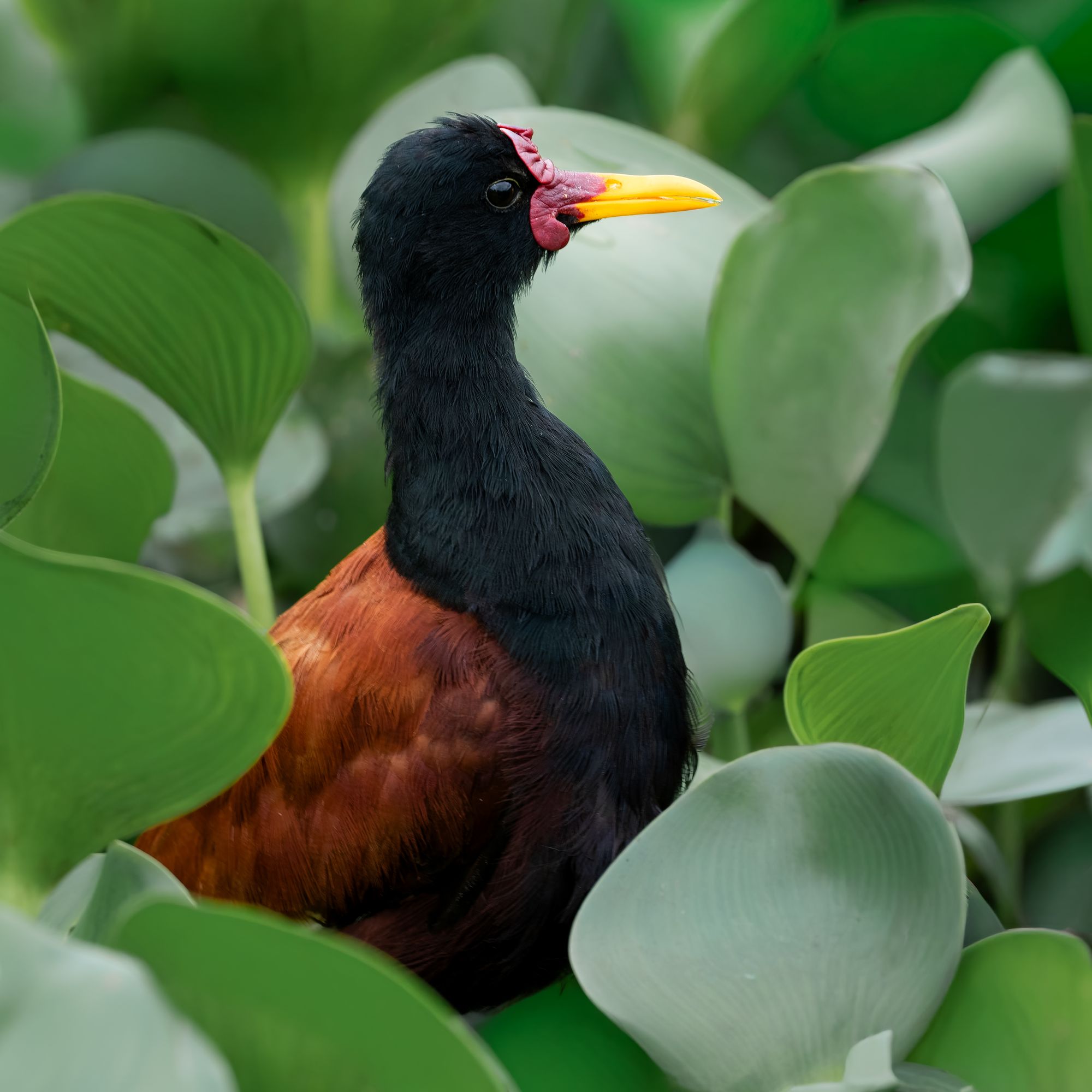
Pantanal revealed exhibition: a territory's soul.
Wattled Jacana, the Feminist Bird
- Date
- 2026
- Location
- Porto Jofre, Pantanal, Brazil
Curatorial text
It is commonly observed in nature that, more often than not, males of the same species are larger and more colorful, traits associated with attracting mates. In the wattled jacana, the pattern is different. The female is larger than the male and assumes a dominant position in the species’ territorial and reproductive organization.
The difference does not end with size. Wattled jacanas are polyandrous: a female may mate with several males, while the males incubate the eggs and assume most of the parental care. Females defend territories and compete for space and mates. Female body size is related to success in territorial competition and in securing mates.
The jacana’s body is remarkably adapted to this environment. Its extraordinarily long toes distribute its weight across the leaves of aquatic vegetation, allowing it to walk over floating surfaces. Territory, feeding, and reproduction are closely tied to the available vegetation.
In the Pantanal, the wattled jacana is also known as “cafezinho.” Small compared with the vast wetlands it inhabits, it establishes its territory on a shifting surface and organizes reproduction according to relationships that challenge what we tend to associate with the roles of males and females.
“Feminist” is a human word, so it does not literally describe the bird. Here, it functions as a provocation prompted by a biological fact: in the wattled jacana, size, competition, reproduction, and parental care are distributed in ways that run counter to expectations we often project onto nature. The photograph captures a small presence among the vegetation; investigation returns that presence to us with a complexity its few inches do not reveal.