Recôncavo: um mundo de muitos mundos e mistérios
Blood Syrup
- Date
- 2026
- Location
- Acupe, Santo Amaro, Bahia, Bahia, Brazil
Curatorial text
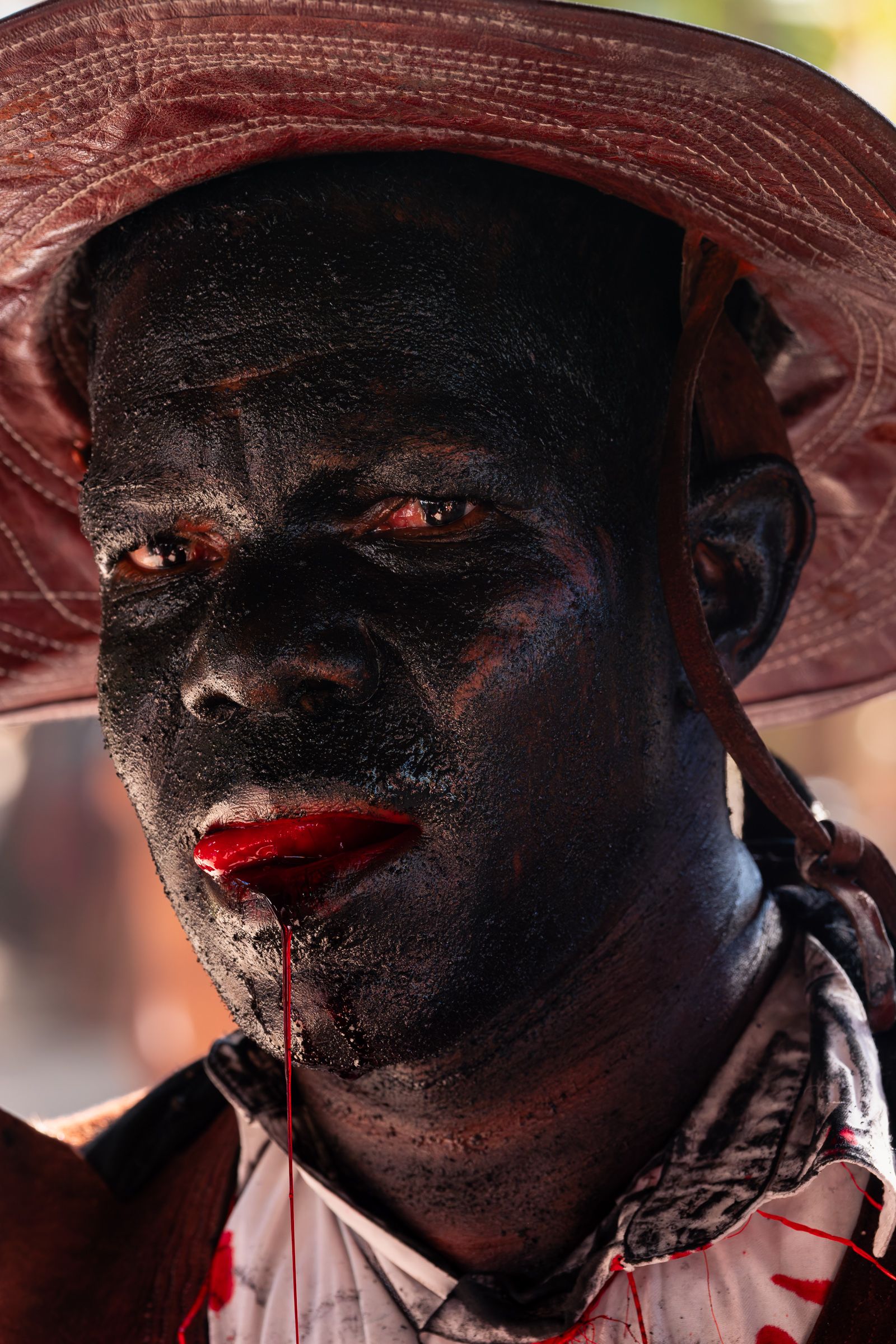
The red syrup dripping from the mouths of Nego Fugido performers is deeply unsettling. It looks nothing like real blood, yet its sweetness makes the image all the more disturbing. Its artificial appearance does not soften the scene. Instead, it draws a stark contrast between the violence portrayed in the performance and the historical violence behind it. There is something disturbing about this mixture of sugar and blood, as though it exposes a contradiction society has learned to hide.
Cake icing belongs to birthdays, celebrations, and the pleasures of childhood. But when it appears around the mouths of performers portraying the violence inflicted on Black people, its familiar sweetness takes on a different meaning. The bright, deliberately artificial red stands in for blood without diminishing the brutality it calls to mind. There is no need for a real wound to evoke a history so often portrayed as natural, necessary, or justified.
Under slavery, skin color became a pretext for claiming ownership over other people’s lives. A physical difference was turned into a justification for deciding who had the right to inflict violence and who was expected to endure it. Economic interests, laws, and moral arguments all served to uphold that brutality, while the suffering of enslaved people was treated as secondary to the interests of those in power. There was nothing sweet about the violence itself. The sweetness belonged to the stories told to make it palatable to those who profited from it.
The cruelest irony may lie in the choice of material. The syrup is meant to add sweetness, yet here it mimics the visible aftermath of violence that was anything but sweet. The mouth, a source of speech, nourishment, and pleasure, becomes the site of an image of suffering. The contrast speaks for itself. It calls to mind the lengths to which society went to justify violence against Black people, turning the color of their skin into a sentence.
One question refuses to go away: How many lives were cut short? How much pain was endured? How many people were denied their worth because of such an arbitrary distinction? Real blood tasted nothing like sugar. It carried the metallic tang of a wound, along with fear, humiliation, and the knowledge that escape was impossible. The syrup cannot reproduce that suffering, and pretending otherwise would be absurd. Yet its artificiality offers a way to confront the normalization of violence that should never have been tolerated.
I’ve always been curious about what that syrup tastes like. The contrast between its blood-red appearance and the promise of a childhood sweetness was precisely what intrigued me. I never tried it. Not because I believe there’s some formal permission required to taste it or leave it alone, but because I don’t feel justified in turning into a personal experience something that evokes suffering I never endured. I can feel the outrage it stirs in me, imagine some of the pain, and be deeply affected by the injustice. But I cannot claim to know what it was like for those who lived through it.
Nego Fugido brings this contradiction to life through a device that looks almost childlike in its simplicity. The red syrup, artificial and sweet, delivers an indictment without having to imitate reality to convey its gravity. What might seem like play unsettles those who witness it. The history of racial violence is no less brutal because the blood is theatrical. And inequality does not vanish when the performance is over.
Love, dignity, and the right to live were subordinated to a hierarchy built on skin color. Even today, skin color is used to judge people’s worth, determine who gets opportunities, and justify unequal treatment. Faced with the syrup, the question is no longer just what it represents. It becomes this: What kind of society needs to sweeten the image of blood before it can face its own history?