Patrimônio Prospectivo: Gravity
Autogyro
- Date
- 2026
- Location
- Subúrbio Skatepark, Bahia, Brazil
Curatorial text
An autogyro, also known as a gyroplane, is an aircraft that uses an unpowered rotor to generate lift and a rear-mounted engine to drive a propeller. Unlike a helicopter, the engine does not turn the rotor. Instead, the rotor spins freely as air passes through its blades. This process, known as autorotation, generates the lift that keeps the aircraft airborne.
Its mechanics involve an intriguing reversal: the rotor does not push the aircraft forward. Its role is to turn the movement of air into lift. A motion that might seem secondary to flight is, in fact, essential to making it possible.
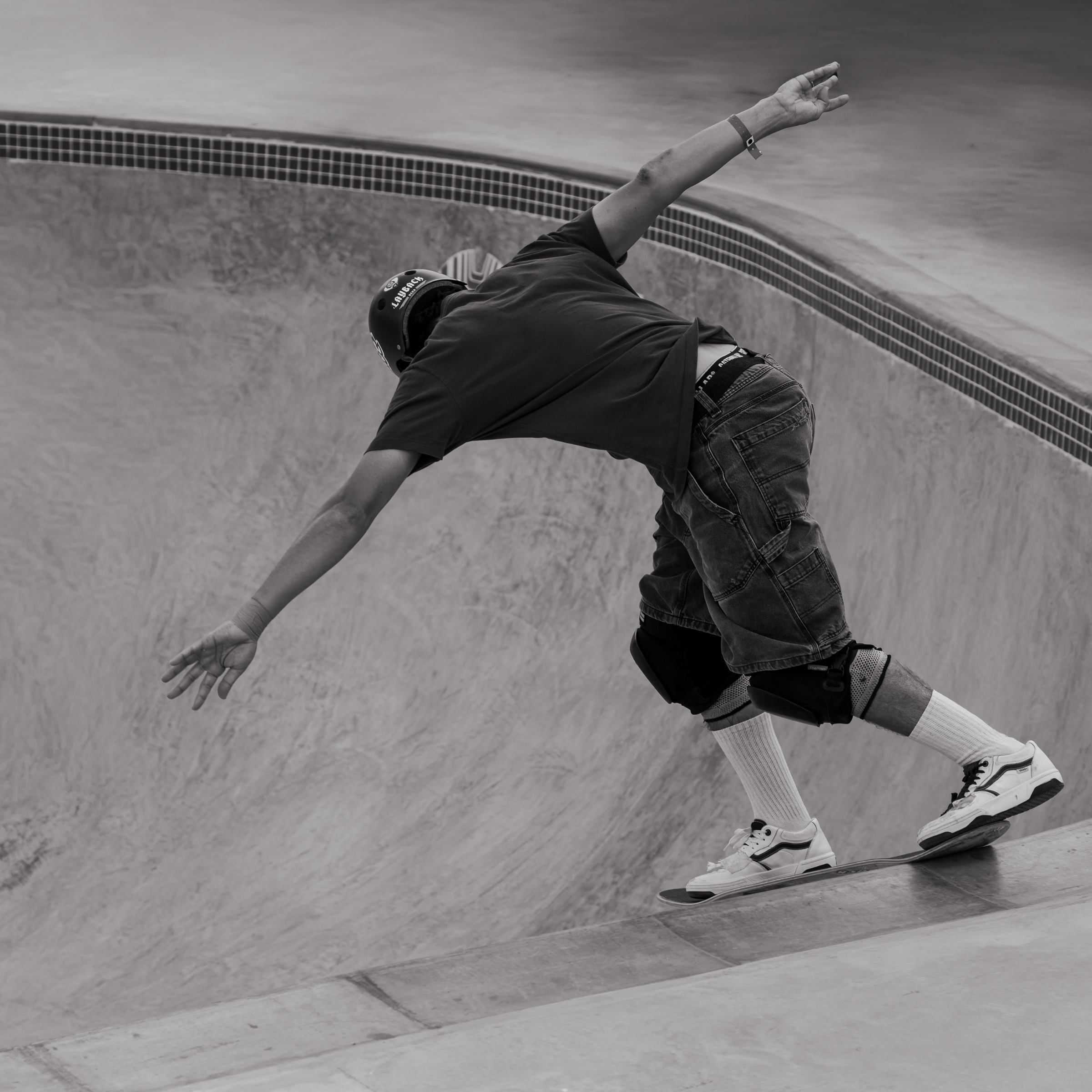
I thought of this principle while taking the photograph. The aircraft’s silent passage changed the scene, but the athlete’s rotating hips gave me a different point of reference. The force of that movement brought to mind the autogyro’s mechanics: energy generated through rotation, movement converted into lift, and momentum turned into the means of clearing an obstacle.
Gravity remains central to skateboarding. Every maneuver depends on it and demands a precise response. The skater does not make gravity disappear or simply resist its force. Instead, the skater learns to work with it, allowing it to become part of the movement and shape the course of the maneuver.
That may be the connection I see between the autogyro and this photograph. Flight does not depend on defeating gravity, but on finding a way to work within its force. Rotation takes on a different role, generating lift through the movement of air. In skateboarding, the body likewise draws on its own momentum, turning movement into the force needed to carry the maneuver forward.