Patrimônio Prospectivo: City
When Houses Set Off and Trains Stay Put
- Date
- 2026
- Location
- Subúrbio skatepark, Paripe, Bahia, Brazil
Curatorial text
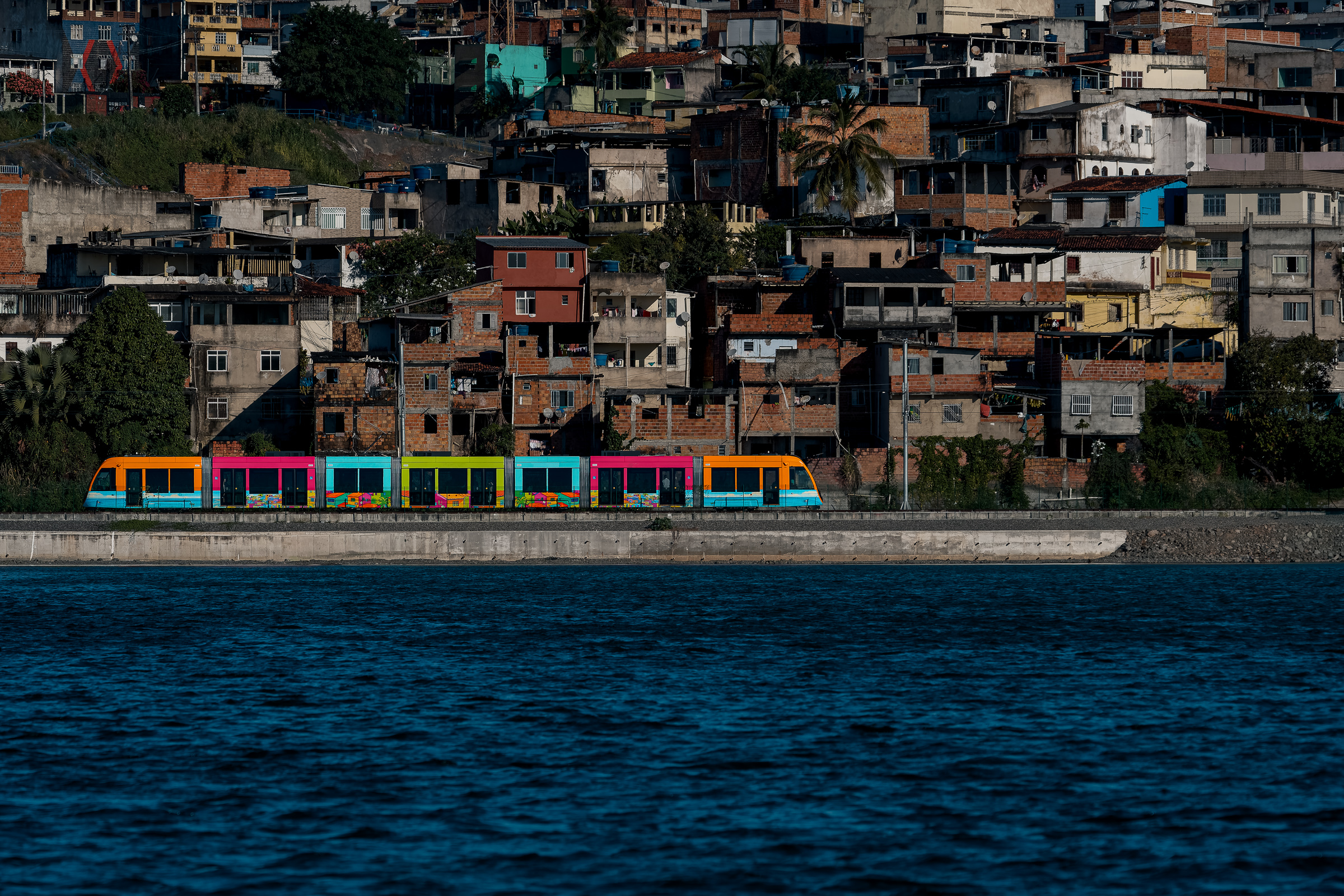
I love this photograph for the sense of unease it stirs in me. What draws me in is the freedom it gives me to imagine different stories within the same urban landscape. I never see it quite the same way twice. Sometimes the buildings clustered along the hillside look like a line of railway cars, individual units coupled together, waiting for departure. At other times, they become houses, each holding the possibility of an entire lifetime. Color plays a decisive role in this transformation. Its variations give each structure a distinct identity, set the volumes apart, and suggest individual personalities. Seen as train cars, they become separate characters in a formation poised to begin its journey. Seen as homes, they become places where joy, sorrow, hardship, achievement, and countless ordinary moments unfold, most of them forever beyond my knowledge. Neither reading cancels out the other. Though confined to a two-dimensional surface, the photograph gives the imagination room to wander beyond what stood before the camera. Perhaps that is what I value most about it: its ability to take me somewhere without my having to move, opening up other dimensions of reality and revealing a different story with every new look.
In Salvador, the relationship between the railway and the homes beside it carries a meaning that goes well beyond their architectural proximity. The city has been shaped by movement, settlement, distance, and the ways people have adapted to their surroundings. These forces have influenced both its expansion and the lives of those who inhabit it. Railway infrastructure woven into residential neighborhoods is part of a larger urban transformation, one whose significance extends far beyond the movement of passengers. There is also a question of recognition in this proximity: public infrastructure becomes part of the lives of communities whose cultural and social identities were already well established long before they appeared in institutional plans. Trains hold out the promise of elsewhere; houses contain the accumulated weight of lives that no timetable can account for. Between the two, the city remains open to interpretation, offering as many readings as there are people willing to look. Perhaps this is photography’s particular freedom: a house can set off without leaving its place, and a train can stay without giving up the possibility of departure.