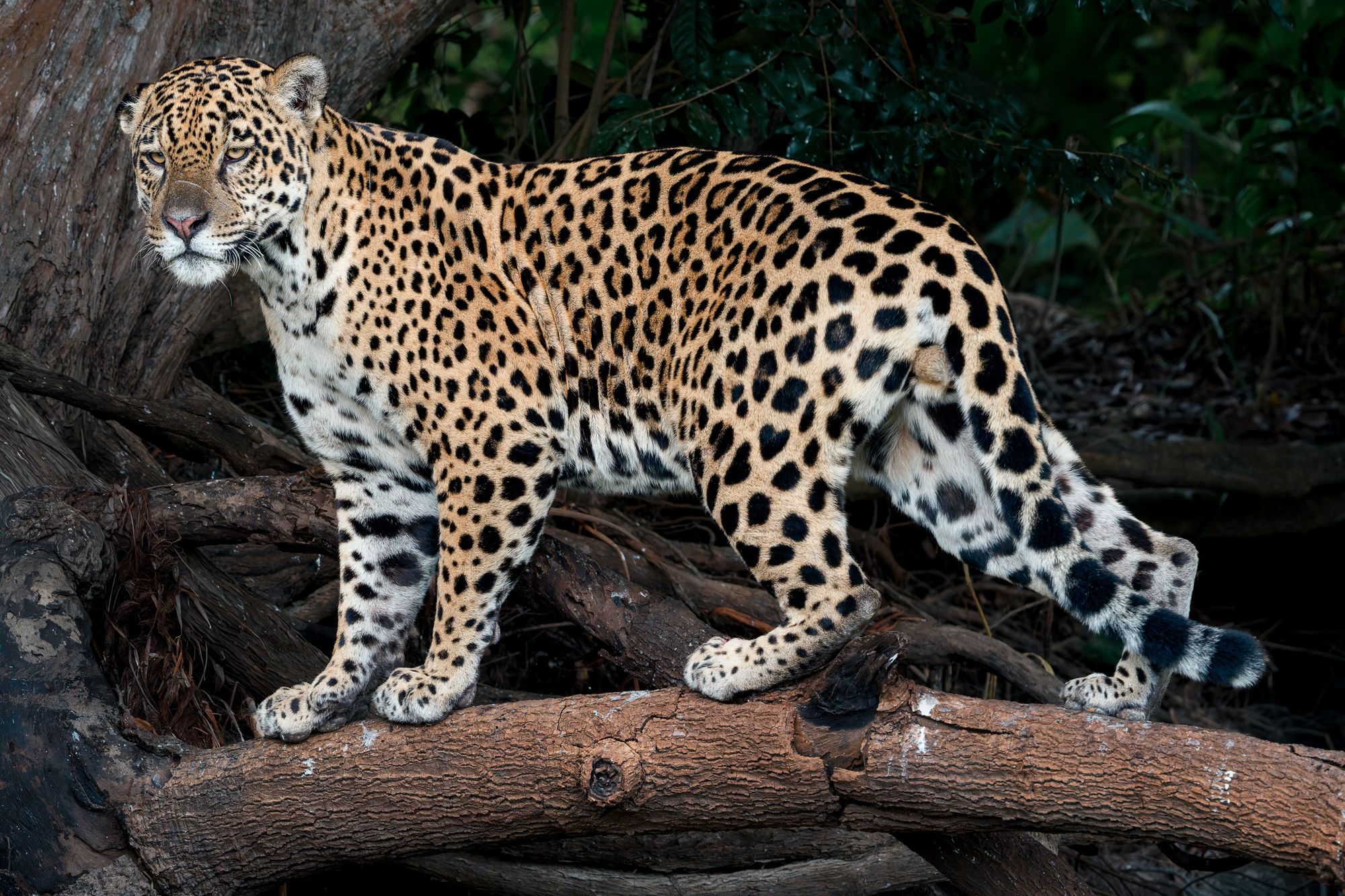
Pantanal revealed exhibition: a territory's soul.
Pantaneiro
- Date
- 2026
- Location
- Porto Jofre, Pantanal, Brazil
Curatorial text
At Porto Jofre, seeing a jaguar is only the beginning. To recognize one is to encounter an individual. The Jaguar Identification Project makes this possible by using the unique patterns of each animal’s rosettes, much like fingerprints allow us to tell one person from another. Over time, those markings make it possible to identify the same jaguar across different sightings and photographs and to follow its story as it unfolds.
The young male in this photograph is Pantaneiro. He lost part of one ear in a fight with another male, and a small scar remains on his face. We never saw the encounters that left those marks. We only see their traces, carried from one day to the next. His rosettes, his damaged ear, and his scar become a kind of signature, allowing this particular jaguar to be recognized again.
There is another part of Pantaneiro’s story that makes him especially remarkable. He spends much of his time with Makala, another young male and his nephew. Makala is Patrícia’s son. Pantaneiro is the son of Medrosa, Patrícia’s daughter. Male jaguars forming such a close association is unusual on its own. Here, the family connection adds another layer to a relationship that has become part of their daily lives.
They hunt together, play, rest, and move through the territory side by side. During the observation, people remained nearby, within the established limits for visitors, while the two animals continued with their routine. What felt extraordinary to everyone watching was simply another day for them.
Porto Jofre draws visitors from around the world who come hoping to see jaguars in the wild. For many, finding one is the reason for making the journey in the first place. Seeing such a powerful animal at close range is difficult enough to describe. Realizing that the jaguar in front of you has a name, a family history, and a life that can be followed over time changes the encounter completely.
The photograph records more than a species. It records an individual: Pantaneiro, with his own markings, scars, lineage, and history.
Among thousands of possible patterns, these belong to him.