Pantanal revealed exhibition: a territory's soul.
Who’s Who
- Date
- 2026
- Location
- Poconé, Mato Grosso, Brazil
Curatorial text
The Pantanal has long been imagined through its wildlife, rivers, fires and vast horizons. That imagery has shaped the region’s place in the visual imagination, often making nature its primary subject. Yet Poconé reveals another dimension of this territory, one sustained through ritual, performance and knowledge passed from one generation to another.
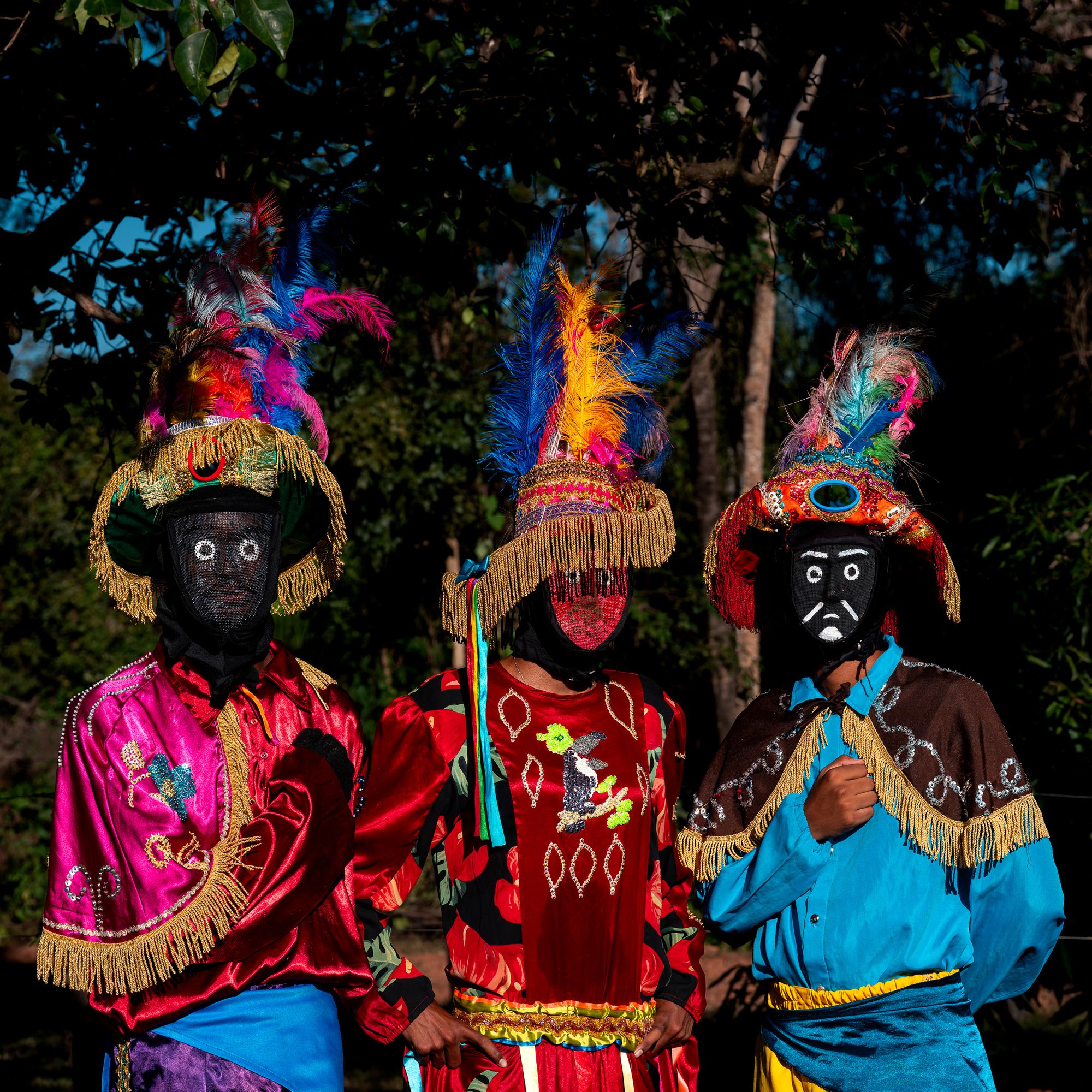
The Mascarados, a masked dance from Poconé, Mato Grosso, make identity itself part of the performance. The participants are traditionally men, who perform both male and female characters. The pink costumes belong to the female characters, while darker costumes identify the male ones. This is a convention of the dance, not a statement about gender outside it. Behind each mask, the identity of the performer remains unknown to the audience. No one knows who is who.
The masks are therefore more than coverings. Together with the costumes, headdresses, embroidery, sequins, mirrors, feathers and intense colors, they construct the characters through which the dance becomes recognizable. Their materials and forms have changed over time, while the practice continues to be transmitted. Tradition here survives through repetition, adaptation and collective knowledge.
This offers another way of understanding the Pantanal. Its fauna is essential to the region’s cultural imagination, but it does not account for the full complexity of its human history. Poconé also carries histories of devotion, music, celebration, craftsmanship and communal memory. These practices belong to the making of the territory itself.
The photograph withholds the faces of three people and, with them, the information that ordinarily anchors a portrait to an individual. What remains is the character, the costume and the shared form of the performance. The mask does not simply conceal a person. It allows that person to enter a tradition whose identity belongs to the group. Here, anonymity is not a lack of identity. It is part of how identity is performed and passed on.