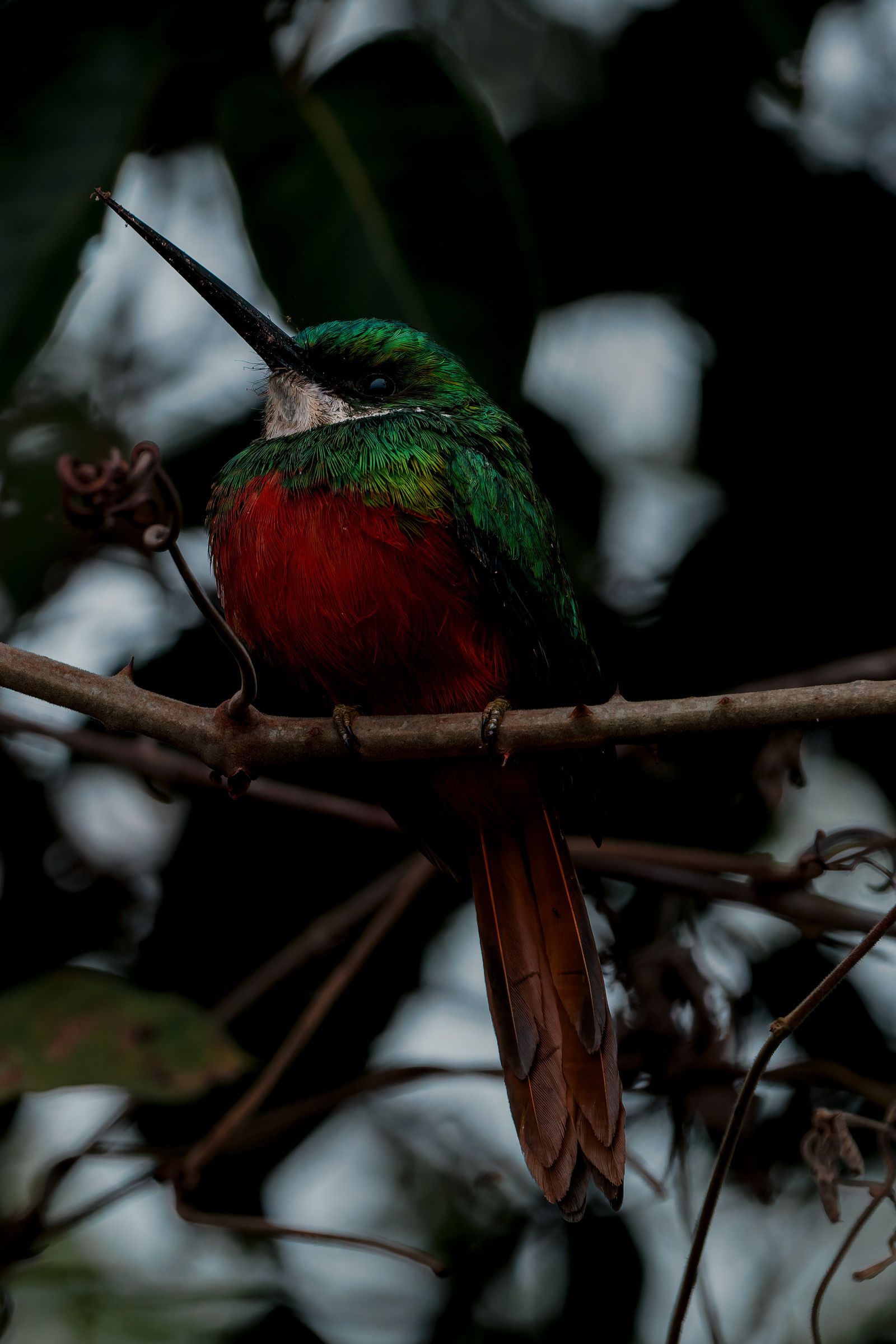
Pantanal revealed exhibition: a territory's soul.
Rufous-tailed Jacamar
- Date
- 2026
- Location
- Porto Jofre, Pantanal, Brazil
Curatorial text
The first thing I noticed was its call. It sounds like a high, almost laughing whistle, beginning in measured intervals before speeding up and climbing higher and higher. Before you see a Rufous-tailed Jacamar, you often hear it first. The sound announces the bird before its body comes into view. This adult male waits on a perch for insects, watching the movement around him before darting out to catch one in flight and returning to the same spot. The waiting, the sudden flight, the return, and that laughter-like call become part of the experience of finding him. The sound is so loud that, for a moment, you could swear it was coming from a loudspeaker hidden somewhere in the forest.
When the bird finally appears, the confusion continues. Its long, slender dark bill and metallic green head and back immediately bring a hummingbird to mind. The resemblance is striking, even though the two belong to different orders: jacamars are classified in the order Galbuliformes, while hummingbirds belong to the Apodiformes.
Then there are the colors, which took me somewhere completely unexpected.
The metallic green and reddish-brown of its plumage immediately brought back the old one-liter glass bottles of Guaraná Antarctica and Brahma. One was green, the other brown. When I was a child, I would go to bars and little neighborhood shops to buy them whenever I was in the countryside or staying at my grandparents’ house. I remember people arguing over which one tasted better, each fiercely loyal to their choice. Those two colors belonged to a very specific part of my childhood.
Here they were again, together in the body of a bird in the Pantanal.
That was the surprise of this encounter. I did not go looking for a childhood memory. The colors brought it back. The call led me to the bird; the bill made me think of a hummingbird; the plumage opened a door to bars, corner shops, glass bottles, the countryside, and my grandparents’ house.
Photography sometimes works this way. What stands in front of the camera can carry memories that have nothing to do with the place where the photograph was made. The Rufous-tailed Jacamar remained exactly what it was: a male bird waiting for insects on a perch in the Pantanal. But for me, its call and its colors made the encounter reach much farther than the forest around it.