The Loveliness of the Strange Portrait
Nego Fugido
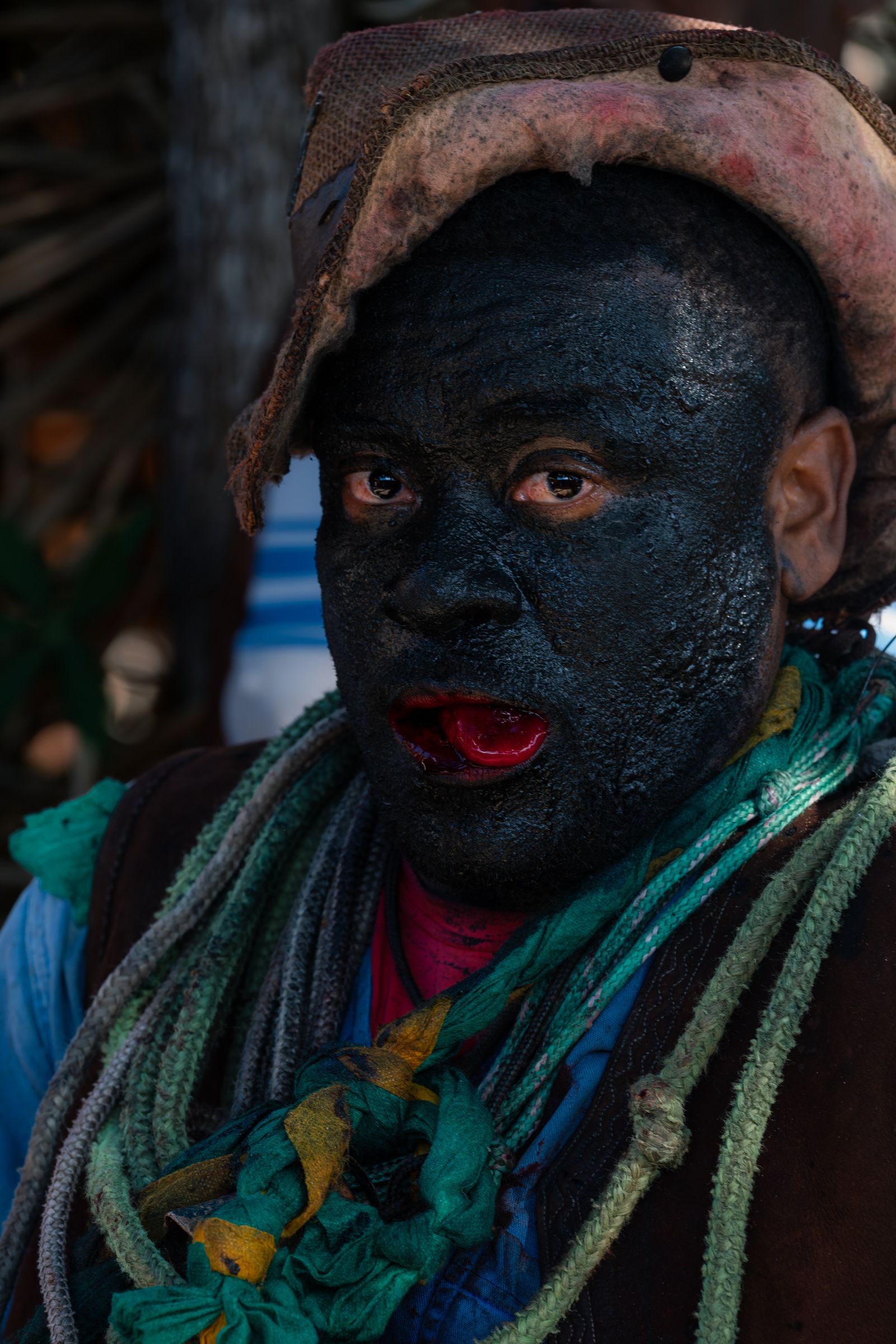
On Sundays in July, the streets of Acupe, a district of Santo Amaro in Bahia’s Recôncavo region, come alive with a tradition that resists easy classification as a festival, theatrical performance, ritual, or historical reenactment. Nego Fugido is an Afro-diasporic community practice that draws on performance, music, dance, face painting, costumes, and direct interaction with spectators to create its own narrative of enslavement, escape, and freedom. Recent anthropological research describes it as a polysemous cultural expression of a quilombola community, whose historical dimension cannot be separated from the way it is performed.
For anyone arriving from outside Bahia, the impulse may be to look for a familiar equivalent: carnival, street theater, historical reenactment. None quite fits. Nego Fugido was not created to illustrate an event safely confined to history books. Its contemporary practice keeps a community-based understanding of enslavement and the struggle for freedom alive, passed down through generations and renewed every July. Academic research still points to uncertainties surrounding its historical origins, which is reason enough to resist inventing a genealogy or imposing a definitive explanation.
Part of its force lies in the coexistence of different forms of expression. The story of escape unfolds through dance, drums, painted faces, characters, pursuit, negotiation, and the participation of those gathered around the action. The Federal University of the Recôncavo of Bahia has investigated this multiplicity through research into performance, photography, film, and sound, in direct dialogue with the Nego Fugido Cultural Association and the residents of Acupe.
For those unfamiliar with Brazilian history, it is important to understand that Nego Fugido emerged from a society built through the enslavement of Africans and their descendants. Its power, however, does not lie in reproducing that past as historical documentation. The community has developed its own way of telling the story. Freedom appears as something enacted, contested, and celebrated, rather than as an abstraction granted by an official chronology. Historical knowledge speaks through the people who enact the tradition.
Photography raises another question. Thousands of photographs made by visitors, researchers, and artists have carried Nego Fugido far beyond Acupe. Anthropological research into these images shows that photographing the tradition also means creating relationships between different positions in relation to it: those who live the practice, those who observe it, those who document it, and those who later encounter the images. A photograph can therefore never account for everything that takes place during Nego Fugido. It offers a particular reading, shaped by a direct relationship with people who already have their own ways of producing and transmitting knowledge.
Perhaps it is precisely this resistance to any single definition that makes Nego Fugido so singular. Its history cannot be fully contained by photography, its performance cannot be fully explained by anthropology, and its narrative cannot be exhausted by the idea of heritage. Each July adds another enactment to what the community has received, transformed, and will pass on again. Nego Fugido does not call for an explanation that would bring it to a close. It demands the kind of attention that can engage with its complexity.