Sacred Skirt
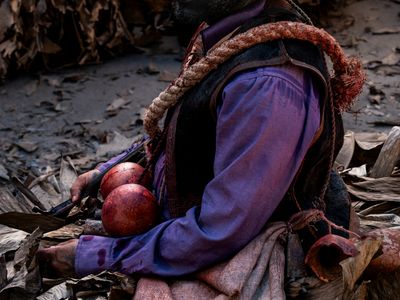
In Acupe, the skirt made from dried banana leaves and worn in Nego Fugido carries a particular connection to the dead and to Egum. Research by Isabela dos Santos Reis at the University for International Integration of the Afro-Brazilian Lusophony (UNILAB) documents accounts from participants in the tradition who say that Egum can hide beneath the banana leaves and that the sound produced by the moving leaves can drive spirits away.
Monilson dos Santos Pinto, an artist and researcher in the performing arts who completed his master’s degree at São Paulo State University (UNESP) and his doctorate at the University of São Paulo (USP), has devoted his research to Nego Fugido. In The Bleeding Banana Tree: Epistemic Disobedience, Pedagogies, and Insurgent Poetics in the Appearances of Nego Fugido, Pinto examines the transmission of knowledge in Acupe and documents the story that enslaved people who were killed were buried beneath banana trees. According to the tradition, when one of these trees was cut, blood would flow from it. Within this account, the banana tree became associated with those who died under slavery and with the continuation of their ties to the community.
The skirt also has a practical purpose documented by Reis. The researcher records accounts describing dried banana leaves as a form of camouflage, a practice that local informants associate with Indigenous knowledge from the region. The leaves allowed the figure to blend into the vegetation, making the skirt part of the action performed during the tradition.
Maria José Villas Boas, an anthropologist and researcher affiliated with the Federal University of Bahia (UFBA) and the Federal University of Rio de Janeiro (UFRJ), has studied Nego Fugido since 2012. Her ethnographic research examines the tradition’s characters, objects, sounds, and practices, including its connections with Afro-Brazilian religious communities. Her studies also document disagreements among Acupe’s religious leaders over whether Nego Fugido should be classified as a Candomblé tradition. Its religious significance therefore needs to be understood through the specific knowledge found within the community, rather than by defining the skirt as a Candomblé ritual garment.
Stela Guedes Caputo, an anthropologist and professor at the State University of Rio de Janeiro (UERJ), has researched religious communities devoted to the worship of Egum. In Knowledge and Memory in the Cult of Egum: The Making of the Body-House of Death, Caputo examines garments used for the manifestation of deceased ancestors. Her study does not focus on Nego Fugido, but it provides a broader context for understanding the religious significance that garments can acquire when associated with ancestors.
The banana plant belongs to the botanical genus Musa, in the family Musaceae. Botanists classify bananas as a group of cultivated species and hybrids, including Musa acuminata. In Acupe, however, its significance is not determined by botanical classification. It is the tradition passed down within the community that connects its leaves to the dead, to Egum, and to the forces activated during the performance.
The skirt brings these dimensions together in a single garment: leaves from a plant associated with those who died under slavery become clothing; their movement produces a sound connected to driving spirits away; their structure allows the figure to conceal itself; and their association with Egum places the garment within a particular understanding of the ancestors. Here, the sacred is not separate from the plant. It is the leaf itself that carries into the performance a history shaped and transmitted in Acupe.