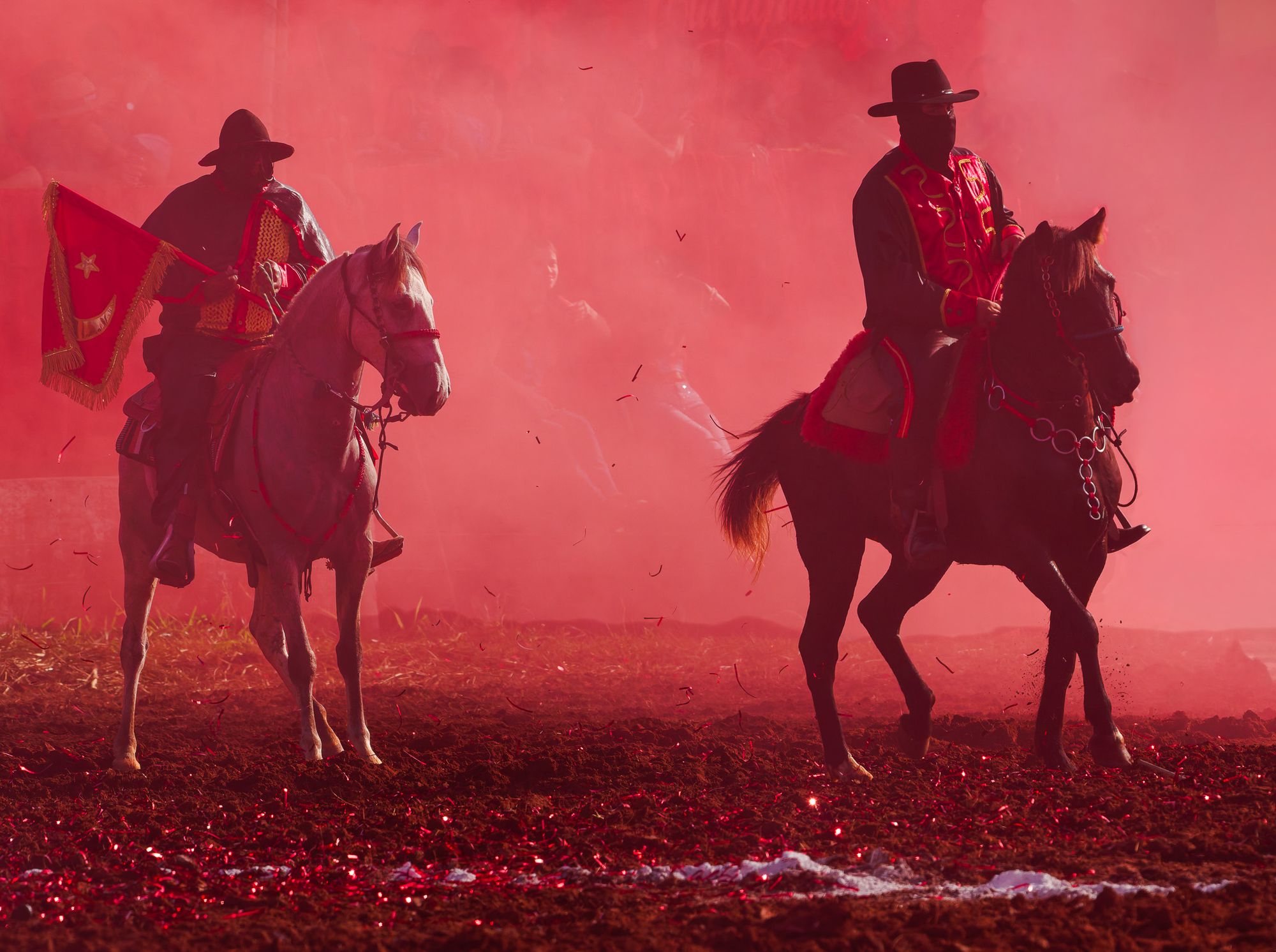
Pantanal revealed exhibition: a territory's soul.
Moorish Red
- Date
- 2026
- Location
- Poconé, Mato Grosso, Brazil
Curatorial text
Poconé did not inherit the Moors. It inherited a story.
Brought across the Atlantic from Portugal, the tradition grew out of the old Christian imagination of Moorish and Christian battles. It reached Mato Grosso in the eighteenth century and, over generations, became inseparable from the community that adopted it. The earliest recorded Cavalhada in Poconé, in 1769, was even identified as a reenactment of the Trojan War. The story of the two armies came later, taking shape only as the tradition found its place in local life.
Red belongs to the Moors. Turquoise belongs to the Christians. Yet in the photograph, color does not stop at identification. Red takes over the frame. It runs through the riders, the horses, the dust, dissolving the boundary between the people performing the story and the landscape around them. That day, the Moors won. I watched their victory unfold and found myself unable to decide whether I wanted them to.
Perhaps Seville has something to do with that hesitation. I lived there long enough to feel a connection to the cultural world behind this imagery. But I was also raised in a Catholic family, and Saint Benedict has remained part of my own relationship with faith. The two histories meet in me without resolving themselves. I would rather leave that tension intact than turn an inherited story into a personal choice.
Every year, the same confrontation returns. The armies gather, the ritual begins, and everyone already knows the ending. Yet knowing does not make the experience irrelevant. The Cavalhada allows the community to enter the story again, to give it bodies, movement, belief, and time.
That may be what I was really photographing.
Not a victory whose outcome was in doubt, but the strange moment when certainty about the story leaves no certainty about where to stand.
The red kept advancing. The Moors won.
I still could not choose.