Pantanal revealed exhibition: a territory's soul.
Cavalhada de Poconé: a symbolic conlict
- Date
- 2026
- Location
- Poconé, Mato Grosso, Brazil
Curatorial text
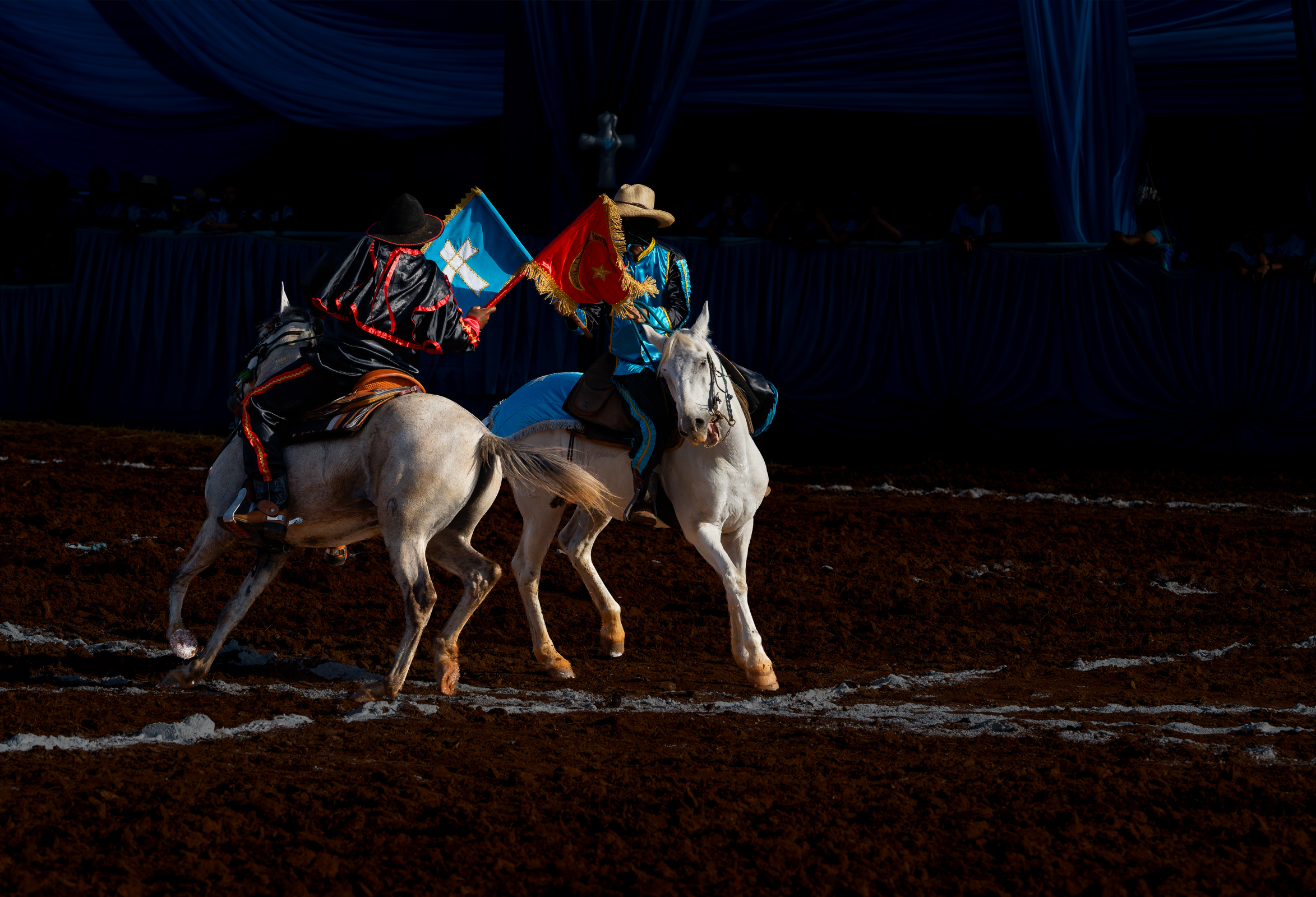
When the flags rise over the field, no one is looking for Carlos Magno. The roads of the Iberian Peninsula are nowhere to be found, either. The names of Moors and Christians remain part of the story, but the landscape has long since become the Pantanal. The dust has no memory of castles. These horses have never crossed Mediterranean borders. And still, the story makes sense, because it has found another place in which to live.
The story arrived as something borrowed. Poconé refused to become its custodian. Instead, the community reshaped its rhythm, brought the old chivalric romance into the calendar of Saint Benedict, and allowed local experience to take precedence over historical fidelity. What began as literature became a collective commitment. Each year, the town does more than revive a distant episode; it reasserts its authority to decide what deserves to be remembered and carried forward.
The twenty-four horsemen know a sequence that has been handed down for decades. Rings, staffs, races, the taking of the castle, and the capture of the Moorish queen follow a precise order. Yet none of these moments stands alone. Each depends on what came before and gives way to what follows, like a manuscript whose meaning depends on the integrity of every page. Remove one, and the whole becomes harder to understand.
Perhaps this is what makes the Cavalhadas of Poconé so singular.
The old conflict never disappeared. It simply ceased to belong exclusively to Europe. The Pantanal did not inherit a finished memory. It received a story open enough to absorb another land, another devotion, and another way of making sense of the world. From that moment on, the story was no longer something that traveled.
It had found its destination.