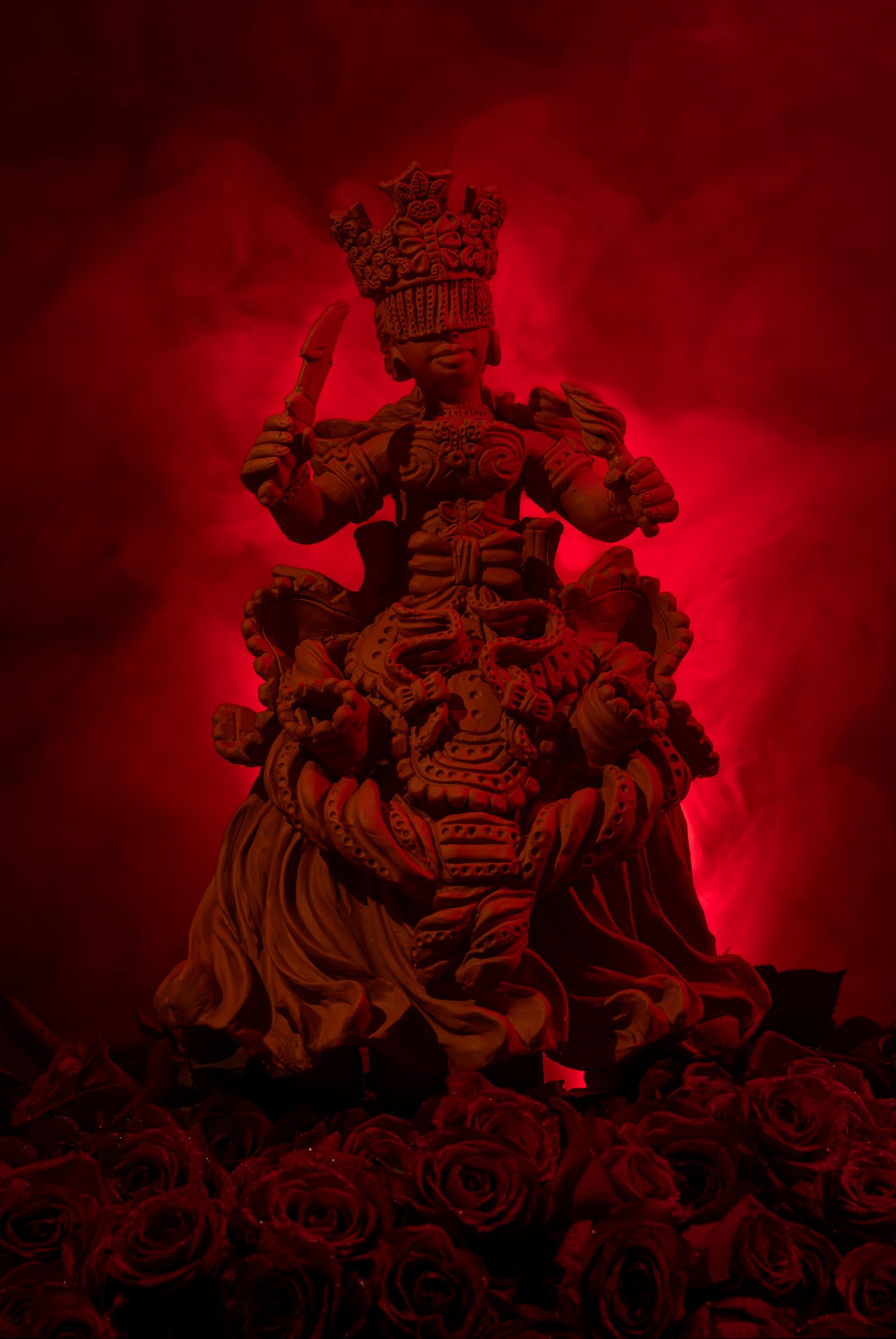
Abelha Rainha Exhibition (Queen Bee Exhibition) - Portugal
Mistress of the winds
- Date
- 2026
- Location
- Salvador, Bahia, Brazil
Curatorial text
Art has to know its limits. When it approaches the sacred, imagination enters territory it can never fully claim as its own. It can reach towards it, give form to what it senses, and offer its own reading. But no work of art can encompass the reality of what it seeks to portray. That boundary is not a failure of artistic expression. It is part of what makes the act of creation meaningful.
Oyá’s significance does not depend on being depicted. Her place in religious life existed long before any artist attempted to portray her, and it remains unchanged by the presence or absence of an image. The title of this work acknowledges that distinction. Calling her Mistress of the Winds is an act of reverence, an acknowledgment of her dominion through language that pays tribute without presuming to possess what belongs to the sacred.
Maria Bethânia’s devotion to Iansã gives this tribute a deeply personal dimension. Her faith belongs to her private life and to a spiritual journey that cannot be reduced to a biographical detail or used as a key to explaining her personality. Bethânia and the orixá are not the same kind of presence, even though their connection runs deep in the singer’s religious experience. Respecting that distinction is essential to honoring the sincerity of her devotion.
Art is at its most honest when it understands what it can express and what must remain beyond its grasp. Approaching the sacred calls for intellectual humility: no deity can be defined by the vision of an artist or confined to the meaning of a representation. A work of art may be offered in tribute, but the sacred itself exists beyond the boundaries of the work.
Oyá is greater than any image. The image is the one that stands before her.