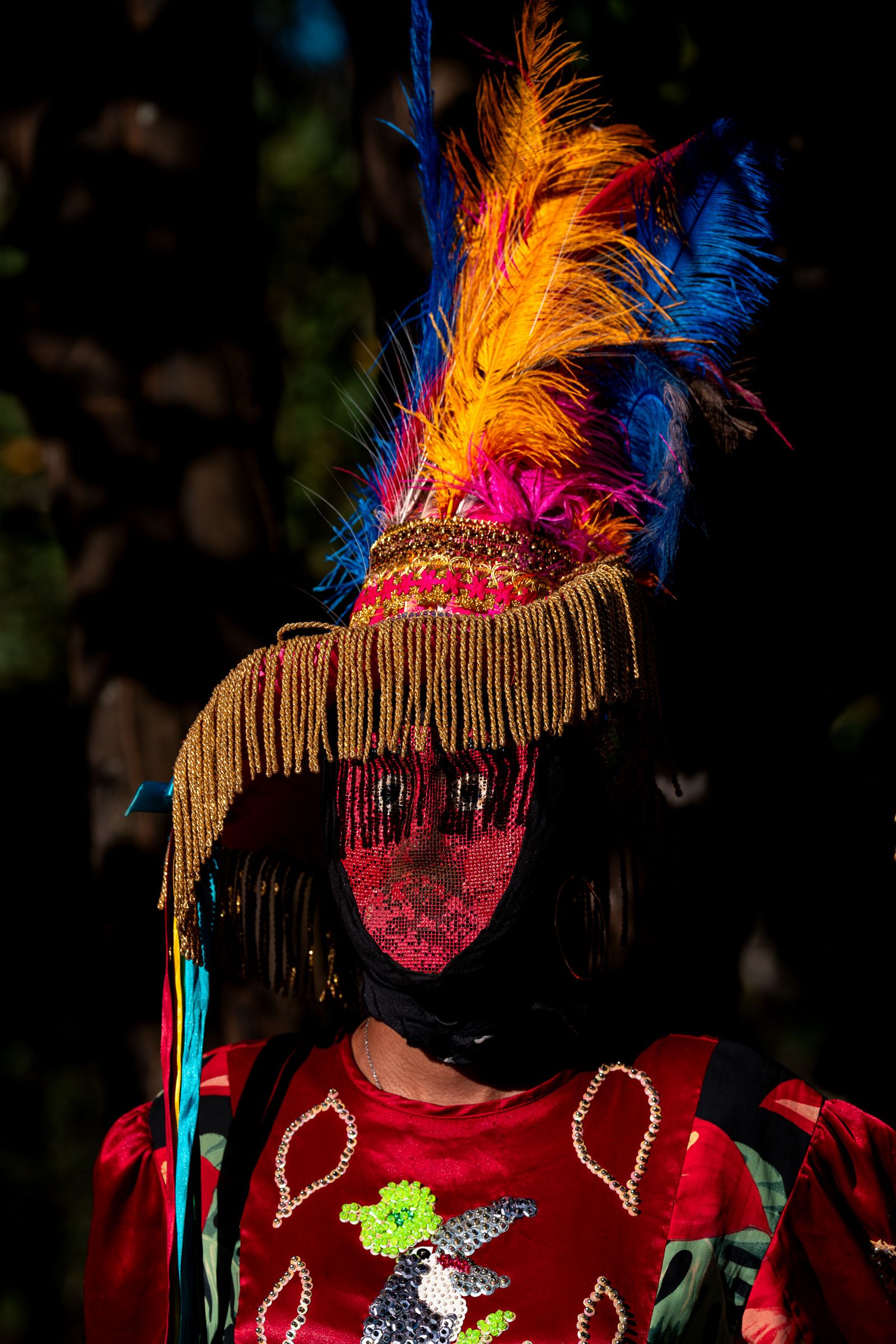
Pantanal revealed exhibition: a territory's soul.
An other Masked Figure
- Date
- 2026
- Location
- Poconé, Mato Grosso, Brazil
Curatorial text
The Mascarados dance of Poconé has existed for more than a century and carries a particularity that says much about the strength of tradition: its participants are men, including those who portray the female characters. In this context, the mask does more than conceal a face. It allows the wearer to assume a character and become part of a cultural form that has been passed down through generations.
A tradition endures because there are people willing to embody it. The characters, costumes, masks, music, and movements reach the present through people who receive an inherited form and bring it back into circulation. Each performance adds a tangible body to a memory shared by the community.
Color is part of this transmission as well. The exuberance of the costumes, the ornaments, and the contrast between their elements create an immediate attraction. There is pleasure in the excess, but there is also recognition. Before knowing who is beneath the mask, we can already recognize a cultural tradition through what its appearance carries.
In this photograph, there is an inversion that interests me. The figure representing a woman is a man; the face disappears beneath the mask; the individual gives way to the character. The identity of the person dancing is no longer the central question. What remains visible is a collective form, received, embodied, and passed on again.
Perhaps this is the power of a tradition: to continue belonging to everyone precisely because, for a while, it can be embodied by someone.