A Performative, Liberating, and Subversive Spirit
In Nego Fugido, the memory of slavery does not remain confined to the past. It returns to public space, takes hold of bodies, transforms faces, and turns the streets into a site of representation. In Acupe, history is not simply remembered. It is brought back into circulation.
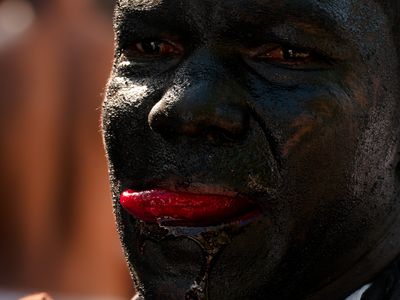
The face in this photograph embodies that process. The darkened skin, red lips, and intense expression do not simply create a fantasy meant to evoke another time. They produce a figure charged with meaning. The body becomes the vehicle for a narrative that has crossed generations and continues to be reshaped by the community.
“Performative” here does not simply mean theatrical. The body, the paint, the red mouth, the costumes, the movements, the cries, the drums, and the occupation of the streets form the very language through which memory is renewed.
Nego Fugido does more than represent a story from the past. It creates a contemporary reenactment of the memory of slavery from the perspective of Black people, shifting the traditional narrative of abolition as a concession toward one of struggle and liberation.
In the photograph, however, the red of the lips takes on another dimension. Associated with violence, blood, and the suffering of enslaved people, it emerges from the black field of the face. It is not simply makeup. It is a sign, a mark inscribed on the body, concentrating violence, theatricality, and memory.
And there is something even more compelling: the photograph does not need to explain the character. The face is already the scene.
Freedom, in this world, does not appear as an abstract idea or as the peaceful consequence of a decision made by others. The narrative enacted by Nego Fugido places Black characters at the center of the conflict. Flight, pursuit, confrontation, and the achievement of freedom shape a memory in which liberty must be fought for.
This is where the performance takes on a political dimension that extends beyond spectacle. What happens in the streets of Acupe is not merely a representation of an event that has already ended. Each repetition renews a relationship with history and preserves the possibility of telling it from another position.
Perhaps that is the subversive power of tradition: not to preserve the past intact, but to prevent it from ever being completely closed.
Nego Fugido endures because there is still something to remember, contest, represent, and change.
And in Acupe, freedom continues to seek a body through which it can exist.