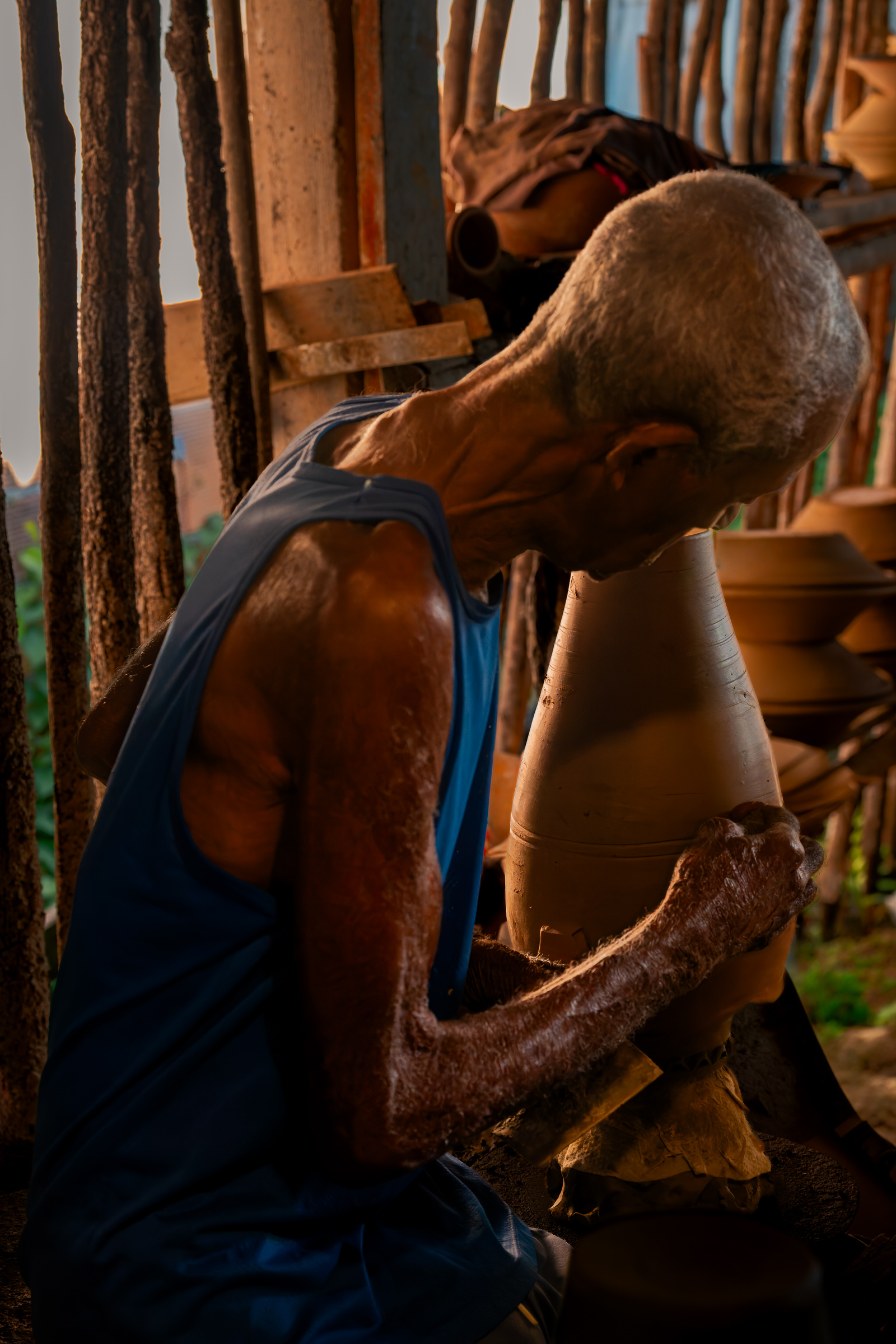
The Clay Marks the Hands
A hand shapes clay, but the clay leaves its mark on the hand as well. The work changes the form of the clay, while years spent practicing the craft change the person who works it. What the hands learn goes beyond technique. It becomes a way of working, a livelihood, and sometimes a way forward for a life still taking shape.
That is when clay becomes more than something a potter shapes. A craft passed down through generations can support families, teach younger workers, and give an entire community tangible reasons to imagine a future. Clay taken from the earth returns as an object, a livelihood, a body of knowledge, and a possibility. What passes through a person’s hands can reach far beyond them.
The idea of a mark contains this reversal. The mark is not confined to the skin. It is also found in what the work does to the life of the person who practices it and to the lives that depend on it. The man shapes the clay, but the clay also shapes the man. The relationship works in both directions.
That reciprocity is what led me to photography. For a long time, I understood photographing as a practice guided by my own choices: looking, deciding, framing, pressing the shutter. Gradually, I realized that the relationship worked in both directions. What I was making was changing the way I looked. Photography altered my expectations, challenged my criteria, and expanded what I considered worthy of attention.
Art can set transformations in motion that were never anticipated when the work was made. An image can change an idea, interrupt an expectation, or open up a possibility that had never entered the mind before. Its reach does not depend solely on what the artist intends, because a work can continue to affect people long after it has left the artist’s hands.
Perhaps that is why this photograph matters so much to me. Clay had already become part of this man’s story long before I made the picture. The marks on his hands are only the most visible sign of a much larger relationship. His life is shaped by the craft, as are the lives of others who depend on it, and the work gives form to possibilities for the future.
The photograph encountered that story and left its own mark. Not on the skin, but on the way I see.
Dense, comforting shadows cut through the incandescent light filling the workshop. Light does not erase shadow; shadow gives light its shape, weight, and direction. The image takes shape through that relationship, just as the work takes shape through the meeting of hand and clay.
Perhaps that is what creation does when it becomes more powerful than its maker: what we set out to shape can eventually shape us in return.