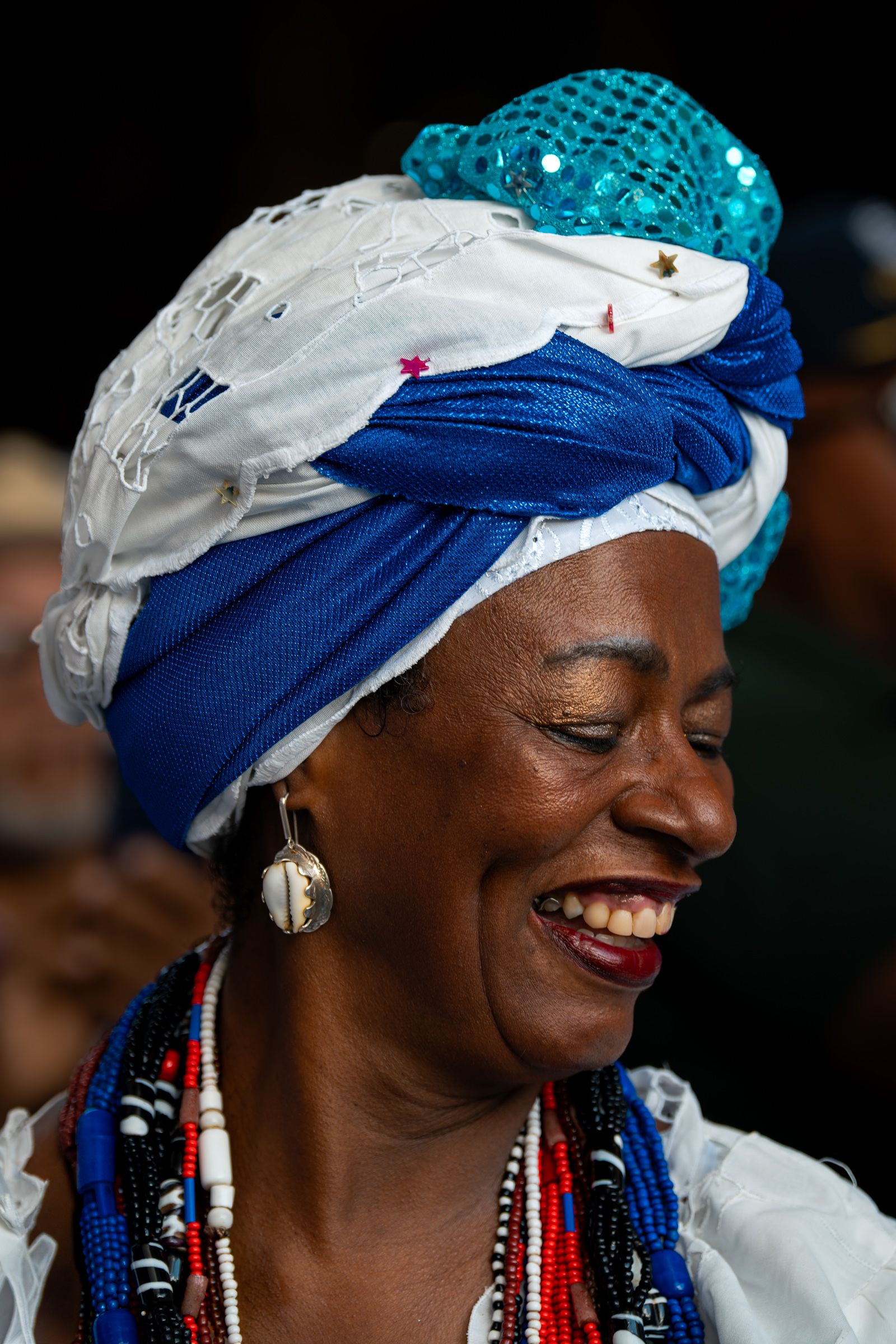
The spell in her smile
The Marujo Olho Vivo Celebration, held at São Joaquim Market, belongs to a religious and cultural tradition that has found its own way of continuing in that place. The celebration brings together faith, music, fellowship, and memory in one of Salvador’s most distinctive settings, where everyday life brings different practices, people, and histories together.
The Bahian woman photographed has an individual relationship with this celebration. The photograph does not need to explain her faith or turn her into a representation of an entire tradition. What we see is a woman taking part in a celebration that holds meaning for her community and, in that moment, offering the camera an expression that belongs entirely to her.
Her smile concentrates the force of the image.
There is something deeply human in that spontaneous joy. It does not need to be interpreted as a symbol of happiness, resilience, or religious devotion. The photograph does not know the whole of her life. It knows that particular second.
That limitation can be a virtue. The portrait does not need to turn the person into a character in a predetermined narrative. It can capture something singular and allow it to carry everything the image cannot reach.
São Joaquim Market expands this idea. Its importance to Salvador’s culture lies precisely in the coexistence of different practices and forms of social life. The Marujo celebration is part of this dynamic. Religious devotion meets commerce, music meets work, and devotion meets everyday life. Each participant adds their own story to the celebration.
For me, the Bahian woman photographed holds something essential within this experience. Her smile does not explain the celebration. It does not need to. It simply happens within it and transforms an ordinary moment into something worth preserving.
Perhaps the mandinga lies precisely in this capacity for joy.
A smile can last only a few seconds and still carry enough force to travel through time within a photograph.